AI
AX Partner: Bridging Business and Technology
AI Development
We deliver a new class of AI agents tailored to our customers’ complex business processes.
From reactive AI to execution-oriented AI
AI Agent
Function
Autonomous actions to achieve objectives
Decision-making Approach
Integrates multiple data sources to execute optimal actions (Proactive)
Technical Components
Data retrieval, API integration, utilization of external tools
Examples
Hyper-personalized wealth management agent, credit card fraud investigation agent ···
AI workers that carry out real tasks
They do more than answer questions—they carry out real tasks.
AI Chatbot
Features
Answering user questions
Decision-Making Method
Responses based on predefined conversation flows (React)
Technical Components
Rule-based, predefined responses, RAG
Examples
General conversational services like ChatGPT, enterprise customer service chatbots ···
AI Information Assistant
Answers user questions and provides information
LLM (Large Language Model)
Function
Generates natural language by learning from vast amounts of data
Decision-Making Method
Generates the most appropriate answer based on probability
Technical Components
Transformer-based natural language processing
Examples
OpenAI GPT-4o, Anthropic Claude 3.5, Google Gemini ···
Brain
The core engine of AI that processes information and learns
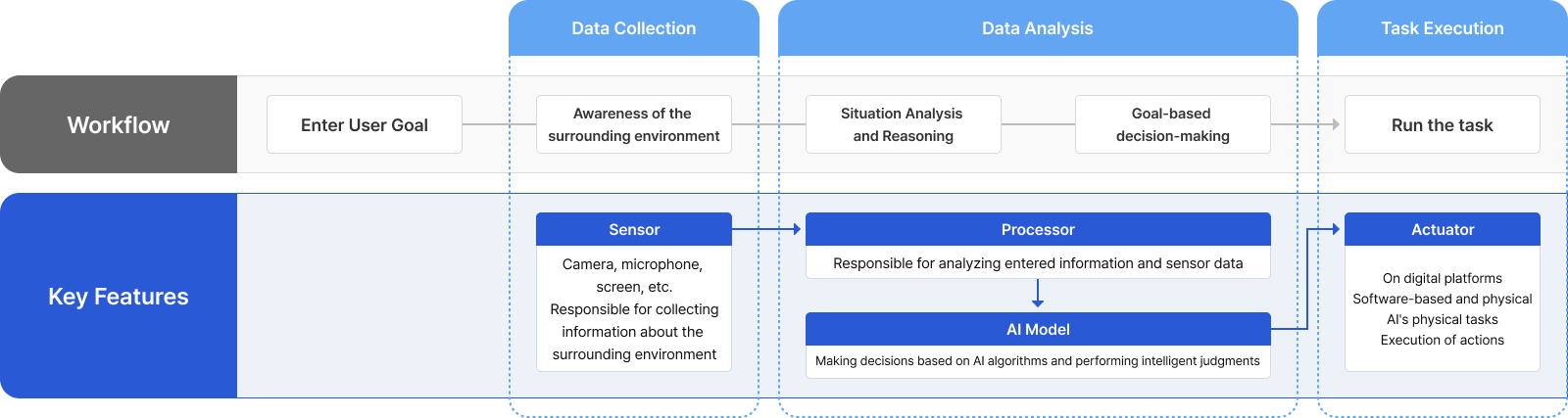
Understanding the Workflow and Architecture of AI Agents
Key Benefits Provided by AI Agents
Key Services
- Natural Language Understanding (NLU)
- Contextual Awareness
- User-Friendly Interface
- Rule-Based Automation
- 24/7 Unattended Operation
- Minimized Error Rate
- Role-Based Specialization
- Inter-Agent Collaboration
- Handling Complex Workflows
- Data-Driven Analysis
- Simulation of Various Scenarios
- Providing Decision-Making Rationale
- 1. User enters a question
- 2. Intent is identified and analyzed
- 3. Required actions are executed
- 4. A response is generated in natural language
- 1. Detect trigger events
- 2. Execute predefined rules
- 3. Record and report results
- 1. Analyze tasks and assign roles
- 2. Execute tasks in parallel across agents
- 3. Share interim results
- 4. Make a consolidated decision
- 1. Collect and analyze data
- 2. Evaluate scenarios using AI models
- 3. Derive the optimal decision
- 4. Present the decision along with supporting rationale
- Agent 1 : Policy analysis
- Agent 2 : Claims calculation
- Agent 3 : Anomaly verification
- Improving Customer Satisfaction
- 24/7 Immediate response
- Reducing the workload of counseling staff
- Processing time reduced by 70–90%
- Labor cost savings
- Unattended processing during nights and holidays
- End-to-end automation of complex tasks
- End-to-End Processing
- Significant improvement in processing speed
- Improved Decision-Making Accuracy
- Risk Prediction
- Ensuring transparency in decision-making