solution
Key Features for the AX Transition
Business Application

DI CUBE ECS
DI CUBE ECS
Complex insurance claim
calculations—now accurate and transparent
We automatically calculate insurance claims based on the latest policy terms
and calculation rules, and provide the rationale behind the results.
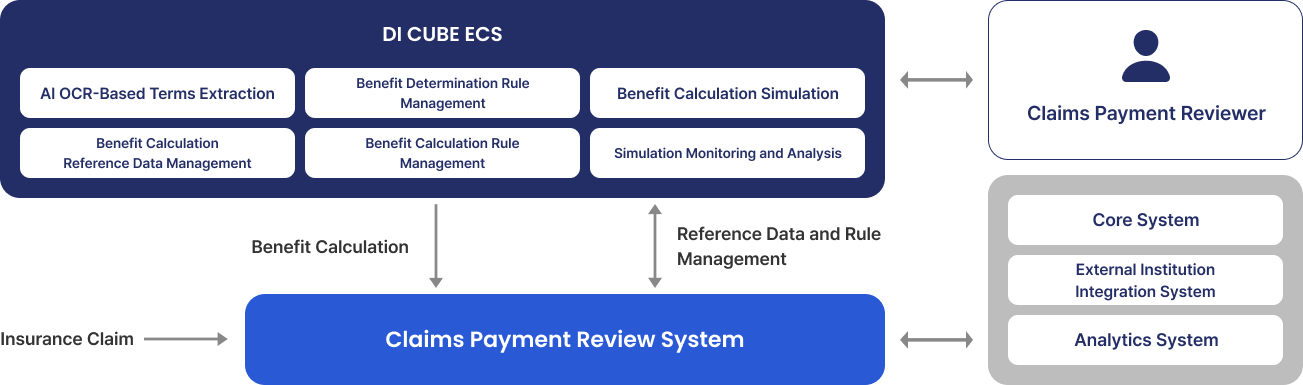
Main Functions
AI OCR-based text recognition and automatic document classification
Automatic Extraction and Verification of Claims Calculation Data
Provision of Policy Analysis Guides and Data Entry Templates
Claim determination and automated payout calculation
Management of Calculation Rules, Criteria, and Change History
User-specific calculations and automatic generation of rationale statements
Key Features
A framework that transforms complex claims calculation from a simple numeric task into a judgment-based process
A framework that combines AI OCR and LLM to automate everything from policy analysis to explanations of calculation rationale
A system that reduces discrepancies in standard interpretation through digital asset management centered on products, coverage, and calculation formulas
Supports precise verification and prevention of overpayments through individual simulations and bulk regression testing
A system that provides explainable calculation frameworks usable for customer guidance, internal reviews, and audit responses
An operational structure that integrates seamlessly with existing claims review and insurance business processes